Modern defence procurement is being reshaped by a difficult reality: precision strike is more important than ever, but traditional high-end weapons are expensive, complex to manufacture and difficult to replace at the rate demanded by contemporary conflict. Defence forces still need advanced missiles for many missions, particularly where extreme speed, survivability, range or highly specialised effects are required. However, the growth of autonomous one-way effectors is creating a new category of precision strike capability: lower-cost, scalable, rapidly adaptable systems that can be procured and deployed in far greater numbers.
A one-way effector, sometimes shortened to OWE, is an autonomous uncrewed system designed to travel to a target and deliver an effect without returning. In practical terms, it may perform a precision strike role, deliver an electronic warfare payload, act as a decoy, saturate enemy defences or help shape the battlespace ahead of more complex operations. Unlike reusable UAVs, one-way effectors are designed around controlled attrition. Unlike traditional missiles, they are often built around lower-cost airframes, modular payloads, open systems architecture and rapid production methods.
This distinction matters because defence planners are increasingly focused not only on what a single weapon can do, but on whether a capability can be procured, adapted, deployed and replenished at scale. In denied and contested environments, where GPS may be jammed, communications may be disrupted and airspace may be defended, the ability to field affordable mass can be as important as the performance of any individual platform.
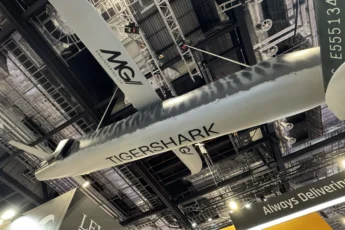
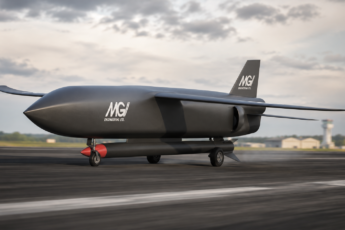
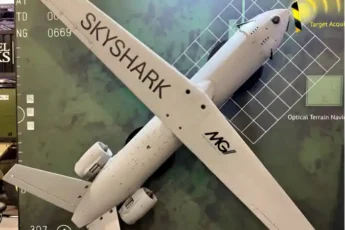
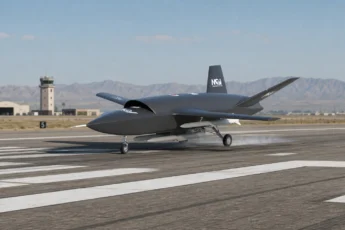
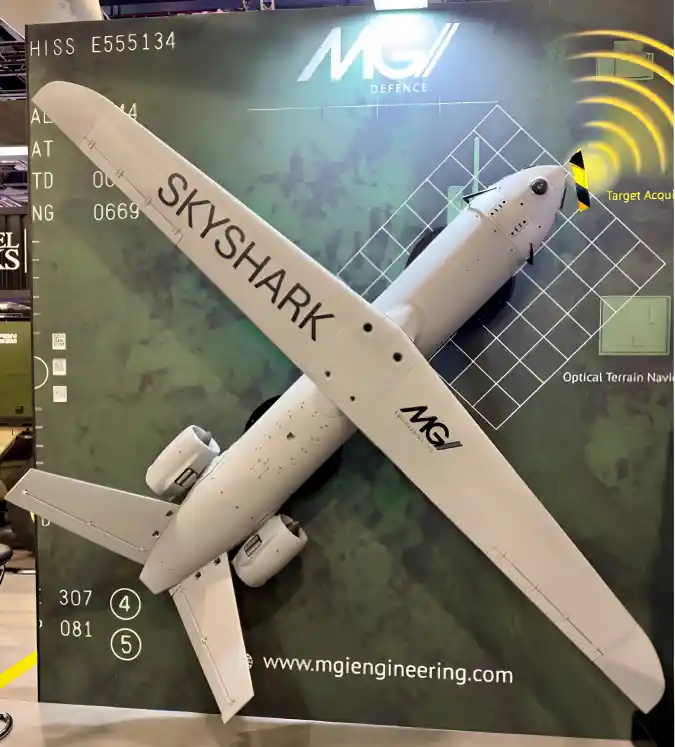
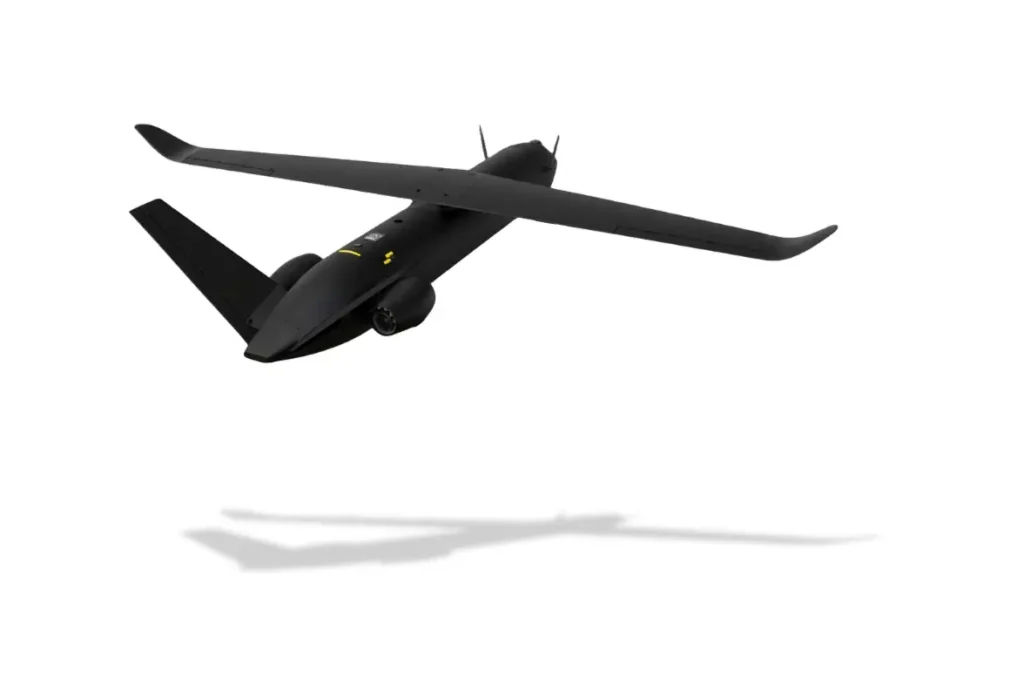
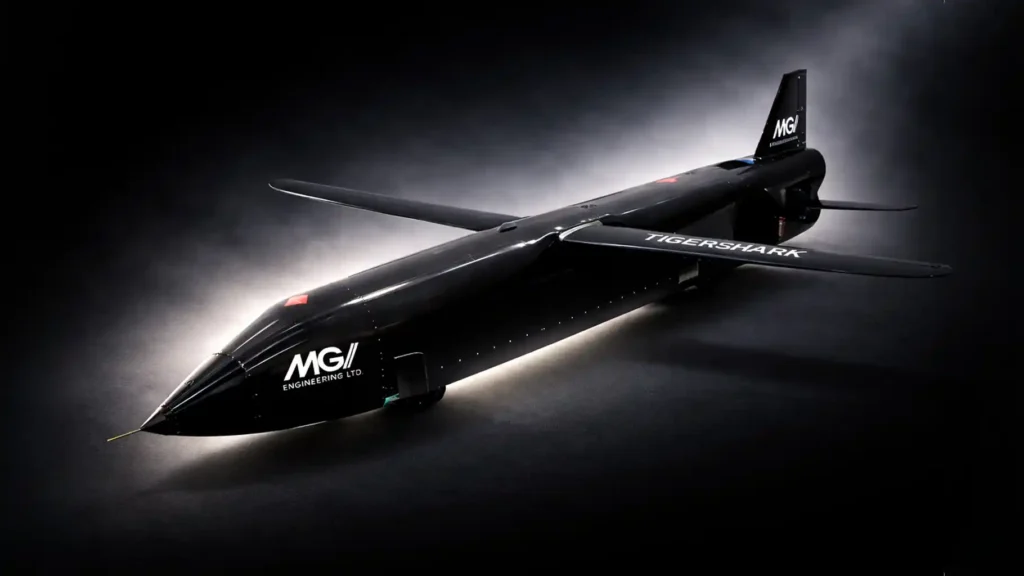
MGI Defence’s TigerShark and SkyShark platforms illustrate this shift. TigerShark is positioned as a high-speed, long-range autonomous one-way effector for deep-strike missions, with a modular payload bay, GPS-free terrain mapping and a design intended for scalable procurement. SkyShark is a smaller, medium-range high-speed OWE designed for operations in contested battlespaces, including active jamming and anti-access/area denial environments. Together, they show how the one-way effector category is moving beyond improvised drone use and into purpose-designed defence capability.
What is the difference between a one-way effector and a missile?
A missile is generally a purpose-built weapon optimised for speed, precision, survivability and destructive effect. Depending on the type, it may use sophisticated propulsion, guidance, seekers, countermeasures and warheads. Missiles remain essential for many roles, from air defence and anti-ship warfare to deep strike and high-value target engagement.
A one-way effector occupies a different space. It is typically an autonomous uncrewed platform designed to deliver an effect at lower cost, with greater emphasis on modularity, production scale and operational flexibility. Some OWEs may resemble small aircraft. Others may look more like UAVs or loitering systems. Their defining characteristic is not simply that they are expendable, but that they can deliver a mission effect without requiring recovery.
The comparison is therefore not “one-way effectors replace missiles.” A better way to understand the change is that one-way effectors expand the precision strike toolkit. They give commanders more options between reusable drones and high-end missiles. They can be used where the target set, threat level or desired effect does not justify the cost of a traditional missile, or where large numbers of lower-cost assets can create a greater operational impact than a small number of premium munitions.
Why cost-per-effect is changing procurement thinking
For decades, defence procurement has often prioritised highly capable systems acquired in relatively limited numbers. That model remains necessary for certain strategic capabilities. However, recent conflicts have shown that stockpile depth, production speed and affordability can become decisive. If a system is too expensive to use frequently, or too slow to replace, its practical battlefield value may be constrained.
One-way effectors address this issue through the concept of cost-per-effect. Instead of asking only how advanced a platform is, procurement teams increasingly ask: what operational effect can be delivered for the money, and how quickly can that capability be fielded, adapted and replenished?
This is where low-cost precision strike drones have a strong procurement argument. They can support a wider range of missions at a price point that allows for operational mass. They can be deployed in numbers, used to saturate or distract defences, and configured for different mission effects. The value is not simply in one vehicle reaching one target. It is in the ability to produce scalable, repeatable, adaptable effects across a campaign.
TigerShark reflects this logic at the heavier end of the category. It is described by MGI as delivering a 200–300 kg modular payload, with high-speed autonomous deep-strike capability and the ability to support salvo launch tactics. SkyShark applies similar principles at a smaller scale, with a 10–20 kg modular payload and a medium-range profile suitable for tactical attrition, decoy use or strike roles.
The role of one-way effectors in denied and contested environments
The modern battlespace is increasingly defined by denial. Adversaries seek to deny access to airspace, disrupt satellite navigation, jam communications and degrade command-and-control networks. This creates a major challenge for conventional UAVs that depend on constant control links or GPS availability.
One-way effectors are especially relevant because they can be designed to operate with a high degree of autonomy. Rather than relying on continuous remote piloting, they can use pre-planned mission profiles, onboard processing, terrain-referenced navigation and terminal guidance. This reduces dependence on vulnerable communications links and makes them more suitable for operating inside contested electronic environments.
TigerShark, for example, is described as combining inertial navigation with GPS-free terrain mapping for operation in GPS-denied and spoofed environments. SkyShark is similarly positioned for GPS-denied operations, with open architecture autonomy and edge computing onboard. These features are important because they speak directly to the operational conditions defence buyers are planning for: not benign airspace, but contested, jammed and rapidly changing environments.
Missiles still matter — but not every target needs one
It is important not to overstate the case. Missiles remain indispensable. They may offer greater speed, survivability, range, specialised seekers, penetration capability or warhead performance. Against certain targets, especially heavily defended or time-critical ones, a high-end missile may be the appropriate choice.
The procurement challenge is that not every target requires such a system. Many missions may demand precision, range and autonomy, but not necessarily the full cost and complexity of a premium missile. In these cases, one-way effectors can provide an alternative layer of capability.
This is particularly relevant for target sets such as logistics nodes, radar sites, communications infrastructure, parked aircraft, fuel stores, command posts, air defence components and other assets where a lower-cost autonomous system may deliver sufficient effect. OWEs may also be used to draw out air defences, confuse sensors, force an adversary to expend expensive interceptors or create openings for other assets.
In this sense, the one-way effector is not simply a cheaper missile. It is a procurement answer to a different question: how can defence forces generate more precision effects, more often, in more places, without exhausting high-end stockpiles?
Attritable systems and the return of mass
The word “attritable” has become central to modern defence thinking. An attritable system is not disposable in a careless sense; rather, it is designed to be affordable enough that its loss is operationally acceptable. This allows commanders to use it in higher-risk environments where sending a crewed aircraft, a reusable UAV or an expensive missile may not be proportionate.
One-way effectors fit naturally into this model. They can be used individually against specific targets, but their greater value often comes from coordinated employment. Multiple OWEs can be launched to saturate defences, approach from different routes, carry different payloads or combine strike, decoy and electronic disruption effects.
SkyShark’s role is especially relevant here. MGI describes it as suitable for swarm or decoy tactics, increasing the probability of saturation, distraction or degradation of adversary defences at a cost point that supports tactical attrition. That is exactly the type of thinking now influencing procurement: not just buying exquisite individual systems, but building force packages that can impose complexity and cost on the adversary.
Open architecture and rapid iteration
Traditional defence procurement can be slow. Platforms may take years to design, test, approve and field. In fast-moving operational environments, this creates a gap between the threat as originally specified and the threat that exists by the time the system enters service.
One-way effectors offer an opportunity to shorten that cycle. When designed around modular payloads, open systems architecture and digital engineering methods, they can be adapted more quickly to new mission requirements. Payloads can change. Software can evolve. Guidance and autonomy functions can be updated. Manufacturing can respond to lessons from live operations.
This is particularly important in electronic warfare, where jamming methods, spoofing techniques and counter-UAS measures evolve quickly. A system that cannot be updated rapidly may lose relevance. By contrast, a modular OWE programme can be treated as an iterative capability rather than a fixed asset.
This aligns closely with MGI’s broader positioning. The company applies Formula 1-derived engineering methods to defence problems, emphasising rapid design, prototyping and manufacture. In the context of one-way effectors, that approach matters because speed of development can become a competitive advantage. Defence customers do not only need a platform; they need the ability to evolve it as the operating environment changes.
Procurement implications: from platform buying to capability scaling
The emergence of low-cost precision strike drones changes the procurement conversation in several ways.
First, it encourages buyers to think in terms of fleet economics. The question becomes: how many effects can be generated for a given budget? A smaller number of expensive weapons may deliver high-end performance, but a larger number of lower-cost effectors may provide greater operational flexibility.
Second, it creates more room for mission-specific procurement. Instead of using a premium weapon for every strike requirement, forces can match the effect to the target. High-end missiles remain available for the most demanding missions, while OWEs can cover a wider range of targets and shaping operations.
Third, it supports faster refresh cycles. If platforms are modular and software-defined, defence forces can procure in batches, introduce updates and adapt to battlefield feedback. This is closer to an iterative product-development model than a traditional long-cycle acquisition model.
Fourth, it strengthens sovereign and allied production resilience. Systems that are simpler to manufacture and easier to scale may help address the stockpile and replenishment challenges that have become increasingly visible in modern conflict.
TigerShark and SkyShark: two examples of scalable OWE thinking
TigerShark and SkyShark are useful examples because they show that one-way effectors are not a single platform type. They are a family of capabilities that can be sized, configured and deployed according to mission need.
TigerShark sits at the heavier, longer-range end of MGI’s OWE offering. Its published specifications emphasise deep-strike reach, a significant modular payload, high subsonic speed, autonomous operation and GPS-denied resilience. That makes it relevant to missions where range, payload and target value justify a larger system, but where the economics and adaptability of a one-way effector remain attractive compared with traditional high-end weapons.
SkyShark offers a smaller and more tactical expression of the same concept. Its published role highlights medium-range autonomous strike, modular payload options, rapid deployment, contested-environment operation and the ability to support saturation or decoy tactics. This makes it relevant for situations where commanders need numbers, flexibility and rapid in-service iteration.
Together, they demonstrate the procurement logic behind the category: different effectors for different mission sets, united by autonomy, modularity, scalability and lower cost-per-effect.
The future of precision strike procurement
The future of defence procurement is unlikely to be a simple choice between missiles and drones. Instead, the most effective forces will use layered strike architectures. High-end missiles will remain vital for the hardest and most strategic targets. Reusable UAVs will continue to provide surveillance, communications and strike roles where recovery is practical. One-way effectors will fill the growing space in between: autonomous, scalable, lower-cost systems designed to deliver precision effects in contested environments.
This is why procurement teams are paying close attention to low-cost precision strike drones. They offer a way to increase mass without abandoning precision. They provide a route to operational flexibility without relying solely on exquisite assets. They allow rapid iteration in response to emerging threats. And they help defence forces impose cost, complexity and uncertainty on adversaries.
For countries facing constrained budgets, contested airspace and rapidly evolving electronic warfare threats, this matters. A one-way effector may not replace a missile, but it can change how missiles are used, how stockpiles are preserved and how precision effects are delivered at scale.
Conclusion
The rise of one-way effectors marks a significant shift in defence procurement. Missiles remain essential, but they are no longer the only route to precision strike. Low-cost autonomous effectors such as MGI’s TigerShark and SkyShark show how scalable, modular and EW-resilient systems can give defence forces new options in denied and contested environments.
The key procurement question is no longer simply: what is the most advanced weapon available? Increasingly, it is: what mix of systems can deliver the required effect, at the required scale, at a sustainable cost, and with the ability to adapt as the threat changes?
One-way effectors answer that question in a powerful way. They combine autonomy, affordability, modularity and operational reach. They give commanders more tools, procurement teams more flexibility and defence forces a more sustainable path to precision strike capability.
For MGI Defence, this is where Formula 1-derived speed, digital engineering and rapid manufacturing meet modern defence demand: not replacing traditional missiles, but helping redefine how precision strike capability is designed, procured and delivered.
FAQ
What is a one-way effector?
A one-way effector is an autonomous uncrewed system designed to deliver a mission effect without returning to base. That effect may include precision strike, electronic warfare, decoy activity, sensor disruption or defence saturation. Unlike a reusable drone, a one-way effector is designed around controlled attrition. Unlike a traditional missile, it is often developed with greater emphasis on affordability, modularity and scalable production.
How is a one-way effector different from a missile?
A missile is usually a highly specialised weapon optimised for speed, range, survivability and target effect. A one-way effector is typically a lower-cost autonomous platform that can deliver precision effects at scale. Missiles remain essential for demanding high-value targets, while one-way effectors give defence forces a more affordable option for missions where mass, adaptability and cost-per-effect are critical.
Are one-way effectors replacing missiles?
No. One-way effectors are not a direct replacement for missiles. Instead, they add another layer to the precision strike toolkit. High-end missiles are still required for complex or heavily defended targets, but one-way effectors can help preserve missile stockpiles by taking on missions where a lower-cost autonomous system is sufficient.
Why are low-cost precision strike drones important?
Low-cost precision strike drones allow defence forces to generate more operational effects for a given budget. They can be procured in larger numbers, adapted more quickly and used in roles where deploying an expensive missile may not be proportionate. This makes them especially valuable in prolonged conflicts where stockpile depth and replenishment speed matter.
What does cost-per-effect mean in defence procurement?
Cost-per-effect refers to the cost of achieving a specific operational outcome, rather than simply the purchase price of a platform. A lower-cost one-way effector may be preferable where it can deliver the required effect without using a more expensive missile. This allows procurement teams to match capability more precisely to mission need.
What is an attritable drone?
An attritable drone is a system designed to be affordable enough that its loss is operationally acceptable. Attritable does not mean low quality or disposable in a careless sense. It means the system can be used in high-risk missions where losing a crewed aircraft, reusable UAV or expensive missile would be disproportionate.
Why are one-way effectors useful in contested environments?
One-way effectors are useful in contested environments because they can be designed to operate with high levels of autonomy. This reduces reliance on continuous remote control, vulnerable communications links or satellite navigation. In environments affected by jamming, spoofing or air defence threats, autonomous effectors can provide a resilient route to delivering precision effects.
Can one-way effectors operate without GPS?
Some advanced one-way effectors are designed to operate in GPS-denied or GPS-contested environments. This may involve inertial navigation, terrain-referenced navigation, onboard processing and other autonomy features. MGI’s TigerShark and SkyShark platforms are both positioned for operation in contested environments where GPS and communications may be disrupted.
What is the role of TigerShark in precision strike?
TigerShark is MGI Defence’s high-speed, long-range autonomous one-way effector. It is designed for deep-strike missions, with a modular payload bay, GPS-free terrain mapping and scalable deployment options. Its role is to provide a lower-cost, adaptable precision strike capability for denied and contested environments.
What is the role of SkyShark?
SkyShark is MGI Defence’s smaller medium-range one-way effector. It is designed for rapid deployment, tactical strike, decoy operations and use in contested battlespaces. Its modular architecture means it can support different mission profiles, including saturation, distraction and attritable strike operations.
What are the main advantages of one-way effectors?
The main advantages of one-way effectors are lower cost, scalable production, modular payloads, autonomous operation and suitability for high-risk missions. They allow defence forces to deploy precision effects in greater numbers and adapt capability more quickly than traditional long-cycle procurement models often allow.
Why are one-way effectors important for modern defence procurement?
One-way effectors are important because they help defence buyers balance capability, cost and scale. Modern conflicts require precision strike systems that can be replenished quickly, updated regularly and used in large numbers. One-way effectors meet this requirement by offering a more flexible and scalable alternative for selected mission types.
Are one-way effectors suitable for deep strike?
Yes, some one-way effectors are designed for deep-strike missions. Larger systems, such as MGI’s TigerShark, can be configured for longer-range precision strike where autonomy, payload capacity and cost-per-effect are key procurement considerations.
How do one-way effectors support swarm or saturation tactics?
One-way effectors can be deployed in groups to complicate an adversary’s air defence response. Multiple systems may approach from different directions, carry different payloads or act as decoys. This can force the adversary to use expensive interceptors, reveal defensive positions or divide attention across multiple threats.
What is the future of one-way effectors in defence?
The future of one-way effectors is likely to involve greater autonomy, improved electronic warfare resilience, modular payload options and scalable production. They will not replace missiles, but they are expected to become an increasingly important part of layered strike architectures alongside missiles, reusable UAVs and other autonomous systems.