Modern military operations are increasingly defined not by the ability to strike, but by the ability to sustain. In denied and highly contested environments, traditional logistics chains are exposed, slow, and manpower-intensive—often becoming a critical vulnerability rather than a force multiplier.
Autonomous systems are changing this equation. But true transformation does not come from isolated platforms. It comes from integrated, end-to-end autonomy, where unmanned systems operate as a coordinated supply chain from point of origin to final delivery.
This is where MGI Defence’s SeaGlide autonomous surface vessel, combined with the R10 autonomous UAV, represents a step-change in how tactical resupply can be executed at range, at speed, and at scale.
The Logistics Challenge in Denied Environments
Supplying forward forces across maritime and littoral environments has always been complex. Today, it is further complicated by:
- Persistent ISR and targeting threats
- Electronic warfare and GNSS denial
- Long distances between safe launch points and forward units
- Limited availability of crewed vessels and aircraft
Conventional ship-to-shore logistics rely heavily on crewed craft, helicopters, and predictable routes—making them increasingly vulnerable in peer or near-peer conflict.
What is required instead is a distributed, low-signature, autonomous logistics architecture capable of operating without constant human intervention or contested communications.
SeaGlide: The Autonomous Maritime Backbone
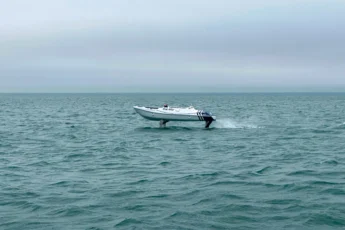
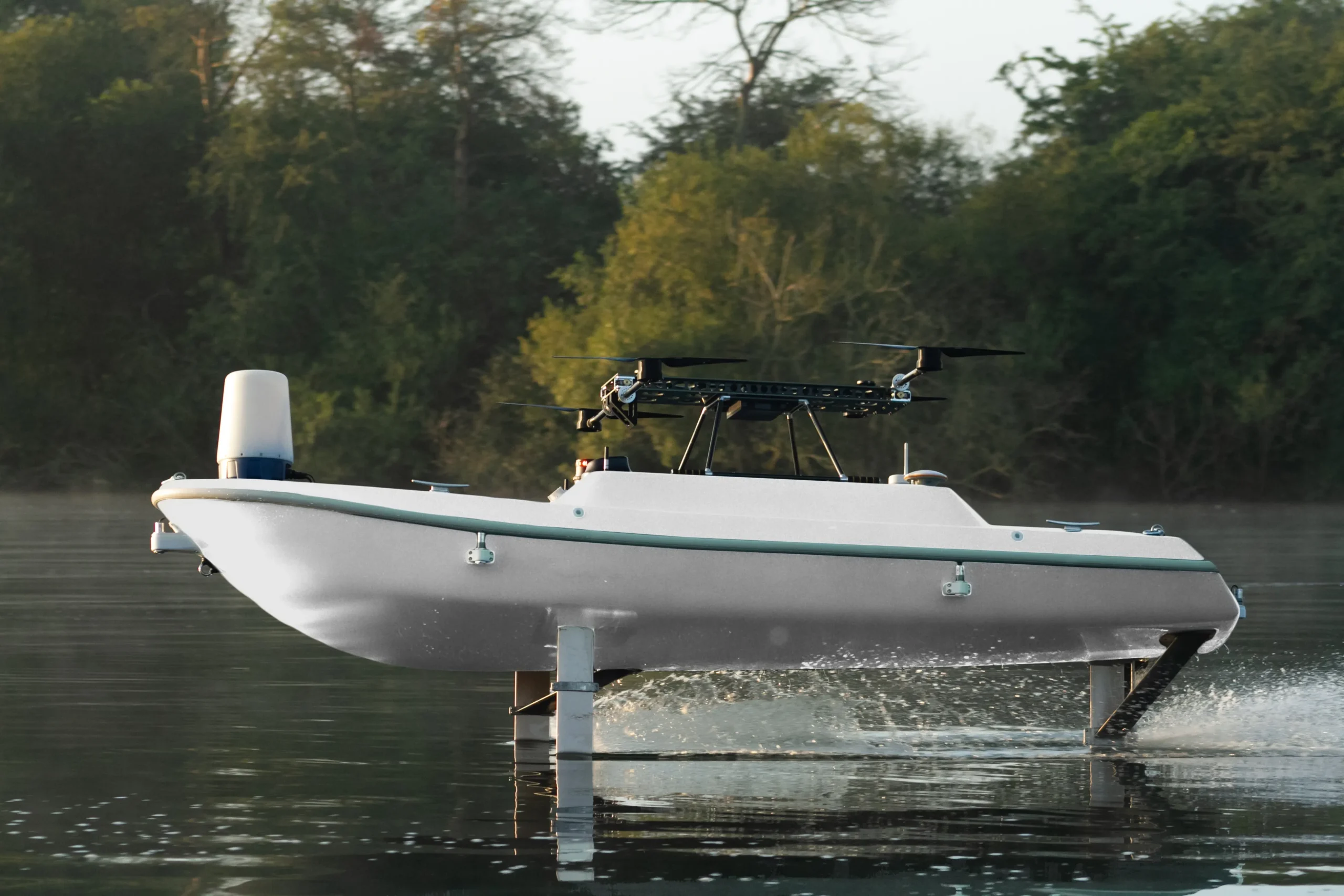
SeaGlide is designed to operate as the maritime backbone of this architecture.
As an autonomous surface vessel (USV), SeaGlide enables long-range maritime transit without placing crews at risk. Its design prioritises:
- Extended operational range
- Low observable maritime profiles
- Autonomous navigation and mission execution
- Operation in GNSS-degraded or denied environments
SeaGlide’s role is not simply transport—it is the first stage of a resilient supply chain, moving critical payloads from secure rear areas or offshore platforms to contested littoral zones.
By removing the requirement for crewed vessels during the most exposed phases of transit, SeaGlide significantly reduces operational risk while increasing persistence.
The “Last Tactical Mile” Problem
Maritime autonomy alone does not solve the logistics challenge.
Once supplies reach the littoral or near-shore environment, the final delivery phase—often referred to as the last tactical mile—is typically the most dangerous. Shorelines, islands, and forward operating bases are frequently under surveillance and fire control.
This is where traditional logistics chains often break down.
MGI’s solution is not to hand this problem off to a third-party UAV—but to integrate it seamlessly into the same autonomous ecosystem.
R10: Autonomous UAV Final-Lift Delivery
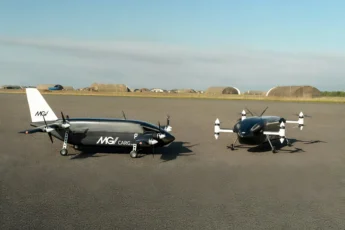
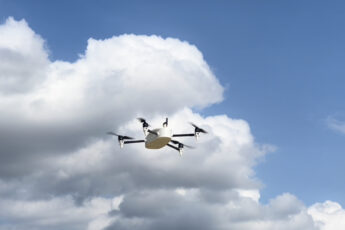
The R10 UAV provides the final-lift capability that completes the autonomous supply chain.
Designed for military logistics and contested environments, the R10 enables:
- Autonomous launch from maritime or austere locations
- Precision delivery of payloads to forward positions
- Reduced acoustic and visual signature compared to crewed alternatives
- Operation without continuous data links
When paired with SeaGlide, the R10 allows supplies to be transferred autonomously from ship-to-shore and onward to inland or distributed units—without exposing personnel or requiring predictable flight corridors.
This creates a continuous, unmanned logistics flow from rear area to frontline.
A Single-Source Autonomous Supply Chain
What makes MGI Defence unusual—and strategically significant—is that both the USV and UAV are developed and produced in-house.
Most defence primes deliver fragmented solutions: a maritime platform from one supplier, an aerial system from another, and integration left to the customer.
MGI delivers something fundamentally different:
- A single-source autonomous supply chain
- Unified systems architecture and mission planning
- Integrated autonomy, communications, and control philosophies
- Faster iteration and adaptation to evolving operational requirements
By controlling both platforms, MGI ensures that SeaGlide and the R10 are designed to work together, not merely alongside each other.
Designed for Electronic Warfare and Communications Denial
End-to-end autonomy is not simply about automation—it is about resilience.
Both SeaGlide and the R10 are designed with contested electromagnetic environments in mind, enabling operations when:
- GNSS is degraded or unavailable
- Communications are intermittent or denied
- Human-in-the-loop control is impractical
Mission execution does not rely on constant connectivity. Instead, autonomy, pre-planned behaviours, and adaptive decision-making allow the supply chain to continue functioning even under active electronic attack.
Scalable, Cost-Effective, and Rapidly Deployable
MGI’s approach is heavily influenced by its F1-derived engineering methodologies, allowing rapid design iteration, prototyping, and production.
For defence customers, this means:
- Faster response to emerging operational needs
- Scalable production of autonomous platforms
- Lower unit costs compared to traditional crewed systems
- Systems designed for attrition-tolerant operations
SeaGlide and the R10 are not bespoke prototypes—they are platforms designed for real-world operational tempo.
Beyond Resupply: Enabling Distributed Operations
While logistics is the primary application, an end-to-end autonomous supply chain unlocks wider operational possibilities, including:
- Sustainment of distributed maritime forces
- Resupply of island chains and remote outposts
- Support for special operations and expeditionary units
- Reduced dependency on vulnerable crewed logistics assets
Autonomous logistics is not a niche capability—it is an enabler for modern force design.
Conclusion: Logistics as a Strategic Advantage
In future conflicts, the ability to move supplies autonomously, discreetly, and at scale may prove as decisive as kinetic capability.
By combining SeaGlide and the R10 into a fully integrated, end-to-end autonomous supply chain, MGI Defence is redefining how maritime and littoral logistics can be executed in contested environments.
Crucially, it delivers this capability as a single-source solution, reducing integration risk and accelerating deployment for defence customers.
Autonomy is no longer about individual platforms. It is about systems that work together—seamlessly, resiliently, and without reliance on constant human control.
Together, they enable a new model for military logistics at sea and beyond.