In modern warfare, the ability to operate without reliable communications, GPS, or data links is becoming a defining factor of operational success. As adversaries deploy increasingly sophisticated jamming and electronic warfare (EW) systems, traditional command-and-control models are proving vulnerable. The next generation of autonomous systems must therefore think for themselves — adapting, navigating, and executing missions in isolation.
At the heart of this shift lies AI-powered autonomy: intelligent onboard decision-making that allows drones and unmanned systems to continue operating effectively in contested or denied environments. For defence clients, this capability represents more than technological advancement — it’s a decisive edge in future conflicts.
From Remote Control to Autonomous Intelligence
Early UAVs relied on constant connectivity. Operators directed flight paths, monitored sensors, and executed actions in near real-time via secure data links. But as electronic warfare has advanced, so too has the risk of disruption. Signal denial, GPS spoofing, and targeted jamming can instantly sever control — grounding assets or, worse, turning them into liabilities.
To counter this, AI-enabled autonomy replaces dependence on external control with onboard intelligence. By combining computer vision, machine learning, and sensor fusion, drones can interpret their surroundings, detect threats, and adapt in real time. These systems no longer wait for instructions — they make their own decisions within mission parameters.
For military planners, this means drones can navigate denied airspace, complete reconnaissance, or deliver payloads even when communications are lost. It transforms the role of the operator from pilot to supervisor, enabling human oversight without requiring direct control.
Operating in Contested Environments
“Contested environments” — regions where communications, navigation, or surveillance systems are actively disrupted — represent some of the toughest operational conditions on Earth. In these theatres, conventional drones may lose GPS accuracy, fail to relay imagery, or even become targets of EW detection.
AI autonomy overcomes these barriers through localised decision loops. Instead of relying on remote servers or command nodes, the drone processes data on the edge — directly on its own hardware.
This approach offers several distinct advantages:
- EW Resistance: AI algorithms can recognise jamming patterns and dynamically re-route or switch frequencies.
- Navigation Resilience: Vision-based navigation allows drones to map and navigate terrain without GPS.
- Mission Continuity: If the control link drops, the drone continues its task based on intent — not just pre-programmed waypoints.
- Adaptive Behaviour: When encountering unexpected conditions, the system can select alternative flight paths or alter its mission plan autonomously.
MGI Defence’s design philosophy — inspired by Formula 1 methodologies — directly supports this new model. By focusing on rapid iteration and modular architecture, MGI enables defence clients to deploy adaptive solutions within weeks, not months.
AI in the Decision Loop
AI-powered autonomy isn’t about removing humans from the equation; it’s about enabling them to focus on strategic intent rather than tactical control. The goal is human-on-the-loop oversight — where operators define mission objectives, monitor system performance, and intervene only when necessary.
Modern onboard AI systems incorporate a hierarchy of autonomy levels:
- Assisted Autonomy – The drone performs stabilisation and route following while the operator issues commands.
- Supervised Autonomy – The drone interprets environmental inputs, suggesting routes or responses for operator approval.
- Full Mission Autonomy – The system plans, navigates, and executes within a defined mission envelope.
By training AI models on vast operational datasets — including flight telemetry, sensor imagery, and simulated combat scenarios — developers can ensure the system behaves predictably even in complex situations. MGI’s engineering teams utilise this approach to validate autonomous logic across air, land, and maritime platforms, ensuring consistent mission performance regardless of domain.
Swarm Intelligence and Collective Behaviour
One of the most transformative applications of AI autonomy is in drone swarming — coordinated operations where multiple UAVs act as a single, distributed entity. Each unit communicates locally with its neighbours, sharing data on targets, threats, and terrain.
Rather than relying on a central controller, the swarm operates on emergent intelligence — a decentralised system where collective behaviour arises from simple local rules. If one drone is lost, others adapt instantly, reconfiguring the formation and redistributing tasks.
In contested environments, swarm tactics dramatically improve survivability and mission success. By overwhelming defences, spreading sensors across wide areas, and providing redundancy, swarms create persistent situational awareness where traditional assets cannot.
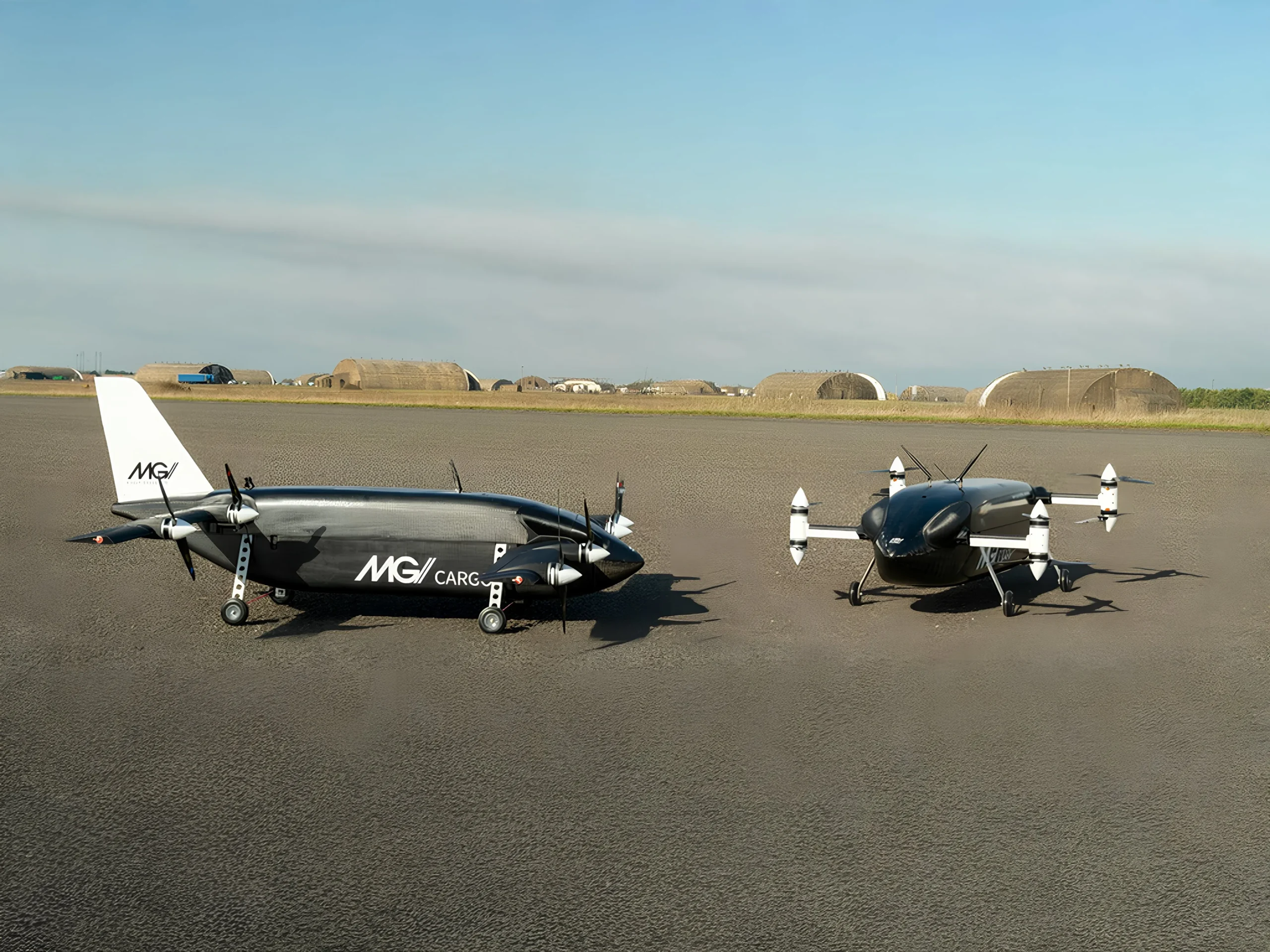
MGI’s Mosquito platform embodies this philosophy — a compact, cost-effective one-way effector designed for mass deployment and coordinated action. When integrated with swarm-enabled AI algorithms, systems like Mosquito can deliver scalable ISR and effect across complex terrain, maintaining operational capability even under heavy EW pressure.
Autonomous Logistics and Resupply
Beyond ISR and strike roles, AI autonomy is reshaping logistics operations in denied environments. The ability to conduct autonomous resupply — delivering ammunition, medical kits, or spare parts without risking personnel — has become critical in distributed warfare.
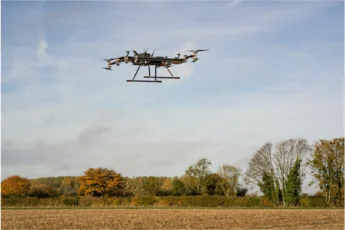
MGI’s SeaGlide and other autonomous logistics solutions use AI-powered route optimisation and obstacle detection to execute ship-to-shore or point-to-point delivery missions without continuous oversight. In maritime contexts, this capability allows resupply under conditions that would be impossible or unsafe for manned craft.
By integrating computer vision with sensor fusion, these drones can detect landing zones, avoid hazards, and adapt to dynamic weather or interference autonomously. The result is an agile, survivable logistics chain that extends combat endurance in austere environments.
AI and the Future Battlespace
As AI-driven systems mature, the battlespace is shifting toward a hybrid model of manned and autonomous assets. Future operations will see AI drones acting as forward scouts, electronic decoys, or precision effectors supporting human-led missions.
These platforms will not only execute pre-programmed missions but also learn from experience, adjusting strategies based on outcomes. Reinforcement learning — where algorithms iteratively improve through simulation — is already reducing the need for manual tuning.
The implications are profound:
- Faster Tactical Response: AI systems react instantly to changing conditions without waiting for operator input.
- Reduced Cognitive Load: Operators manage mission intent rather than low-level control.
- Scalable Production: Modular AI systems can be replicated across fleets, reducing per-unit cost and enabling mass deployment.
MGI’s approach to autonomy emphasises modularity, rapid iteration, and affordability, ensuring clients can adapt quickly as mission requirements evolve. Whether for ISR, logistics, or strike, the company’s AI-enabled platforms are engineered to operate independently — yet integrate seamlessly within wider command architectures.
Ethics, Oversight, and Human Control
As autonomy advances, so too does the responsibility to ensure ethical operation. The debate around AI in defence often centres on control, accountability, and compliance with international law.
MGI supports a clear “human-on-the-loop” framework, ensuring every autonomous action occurs within a predefined envelope of intent and safety. Systems are designed to maintain audit trails of decision-making, enabling transparent post-mission review and continuous learning.
Far from removing the human role, AI autonomy enhances it — allowing commanders to direct strategy with greater precision, informed by real-time autonomous data collection and interpretation.
Conclusion: Intelligent Systems for a Contested Future
AI-powered autonomy is redefining what’s possible on the modern battlefield. As adversaries invest heavily in electronic warfare and denial capabilities, the ability to operate — and win — without communication or GPS is becoming the new standard.
MGI Defence is at the forefront of this transformation, applying F1-inspired rapid development to deliver scalable, resilient autonomous platforms that combine intelligence, adaptability, and affordability.
From SeaGlide’s ship-to-shore resupply missions to Mosquito’s swarm-enabled ISR and effect, MGI’s systems demonstrate how AI-driven autonomy can preserve operational freedom — even in the most contested environments.
In the coming decade, intelligent autonomy will not just support defence operations — it will define them.